Why a studio? Leaders today face many challenges that require them to design or redesign organizational activities and decisions to achieve and sustain high performance. While best practices from other companies, consultants, and business books may be effective, they seldom yield the high performance achievable with a custom “bespoke” solution. What is needed is a flexible methodology and framework, along with a space to reimagine the organization.
Originating from the Latin word “studium,” meaning to study, the Italian word “studio” means a place to study or work. Organization Design Studio® is a virtual space for analyzing organizations and learning through hands-on design practice. It is a place to work on the organization, rather than working in it. The studio includes 12 labs that guide the inquiry and innovation needed for custom designs (Latham, 2012).
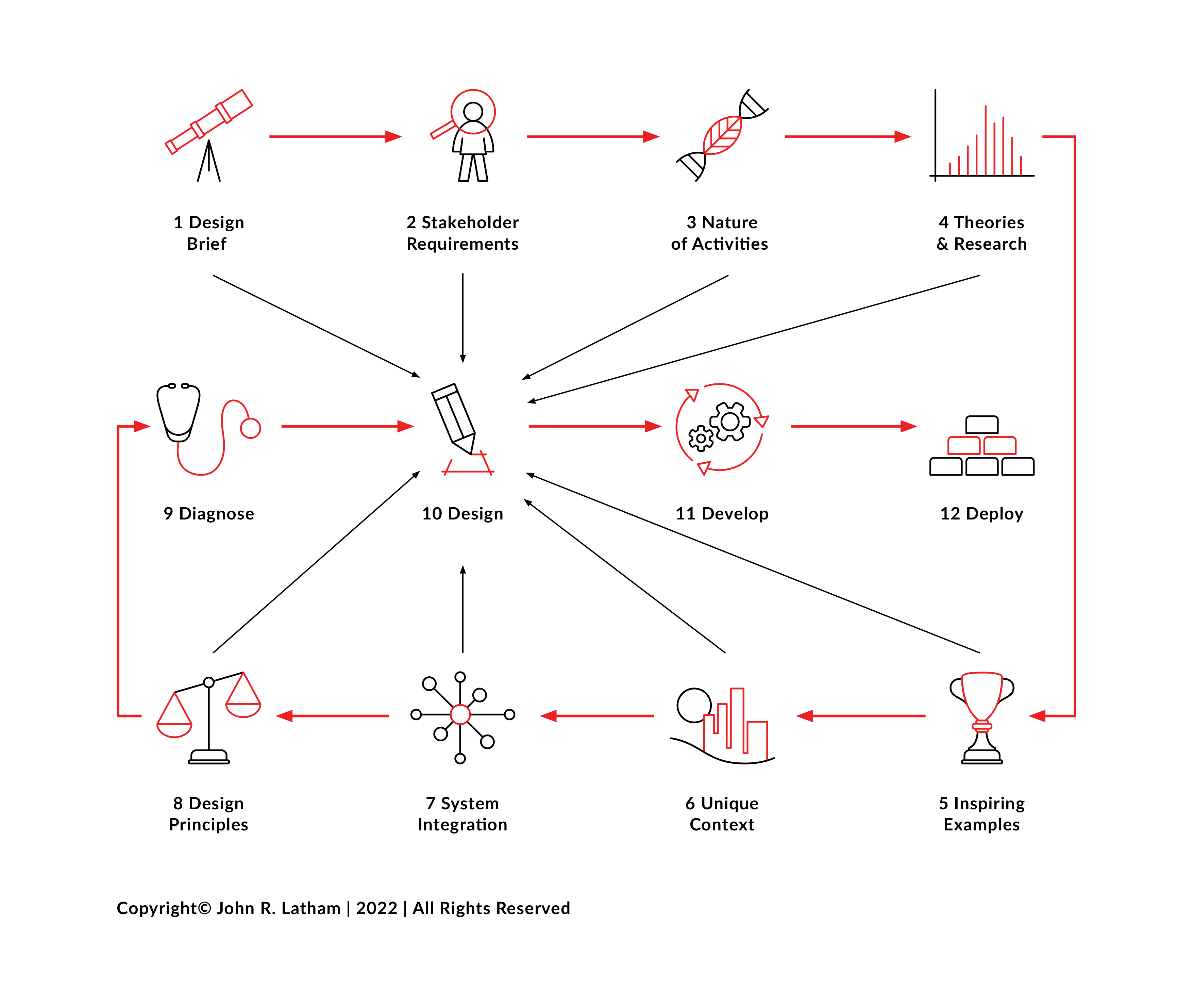
Beginning with the purpose, the studio is human-centered, addressing the stakeholders’ requirements and the nature of the activities and decisions being designed. The labs combine the best of academia and practice using empirical evidence and inspiring examples to inform the design process. The real power in organizational design lies in aligning the activities and decisions with the unique organizational context and integrating them with other relevant activities and decision-making processes.
Based on these inputs and design principles, the existing system is evaluated to identify which characteristics to retain and which require redesign. The studio approach then combines critical analysis with creativity to design, develop, and deploy your new system. Organizational systems are never complete; they require continuous evaluation and improvement to remain relevant in an ever-changing world. Our labs offer a “learn by doing” experience, where you build your design skills by creating a custom system tailored to your organization's specific needs.
1. Design Brief Lab
Organization design is a rational, purpose-driven process that enables the achievement of specific objectives and results. The first step in the design brief is to identify the leaders’ intent - the WHY. What are the purposes of the system being designed? What are the expected benefits? Based on the purpose, determine the project's scope. WHAT is included and what is excluded? What activities and decisions will be part of the systematic approach? Which parts of the organization will be involved in this system? Then identify WHO will be included on the design team. When it comes to design, if two people think alike, one of them is unnecessary. The design team ideally consists of diverse perspectives that address key aspects of the scope and relevant aspects of the larger organizational system. Then develop a project management plan outlining HOW, WHEN, and WHERE the design team will carry out the design activities. These components are explicitly defined in a formal document, the design brief, that can be shared and revised as the project unfolds.
- 1.1 Leadership Intent - WHY - Identify and understand the external and internal forces for change. What is motivating the design or redesign of a system? Identify the purposes and expected benefits of the new system.
- 1.2 Project Scope - WHAT - Identify the activities and decisions included and which are excluded? Identify which parts of the organization will be included, such as departments and functions (breadth) and the organizational levels (depth).
- 1.3 Design Team - WHO - Identify and select the participants that will comprise the core design team. Base the team composition on a mix of organizational experience, technical knowledge, and country-specific cultural experience and knowledge, as well as diverse demographic perspectives.
- 1.4 Project Plan - HOW, WHEN, and WHERE - Develop a design project plan following the remaining 11 design labs, including a schedule and locations for the activities.
- 1.5 Project Management - Manage the three main aspects of any project, including the scope, resources (team), and schedule, to produce the quality design that you want. Review and analyze the three elements and their interconnections to keep the project on track.
2. Stakeholder Requirements Lab
Long-term value creation requires a deep understanding of the individuals involved in the activities and impacted by the results. This stakeholder-centered approach begins with the three core stakeholders: investors (the funding source), customers (the beneficiaries of the solutions), and the workforce (those who create the solutions). These three groups are interdependent, and each depends on the others to succeed. Suppliers and partners (both external and internal) can also be essential considerations, as they are integral to the success of creating and delivering the outputs of the designed approach. Finally, society and the natural environment are often crucial considerations in designing organizational activities and decisions. Once you have identified the relevant stakeholders for the system being designed, determine how they are involved, including those who are active in the system, those who are impacted by it, and those who represent the interests of the first two. Then identify their specific requirements. Those are the requirements that the approach being designed must meet. The stakeholder lab tools and techniques help you explore multiple stakeholders, identify their requirements, and determine which stakeholders and requirements your design will address. Finally, a deep understanding of stakeholders and what it is like to be them enhances the designer’s ability to create solutions that truly solve the problems intended.
- 2.1 Stakeholders Identified - Identify the key stakeholder groups and sub-groups applicable to the system being designed, and categorize each group based on their relationship to the system being designed, including involved, impacted, and influencer.
- 2.2 Categorized - Categorize the stakeholders from Lab 2.1 into three groups, including involved, impacted, and influencers.
- 2.3 Requirements - Identify the requirements for each stakeholder group based on existing sources and listening methods.
- 2.4 Empathy - Understand what it is like to be a member of each group - develop an empathy profile for a key stakeholder group, including what they see and hear, think and feel, and say and do.
3. Nature of Activities Lab
Organizational approaches are interconnected combinations of physical, digital, and human components that make up the inputs, activities, decisions, and outputs. These socio-technical, systematic approaches range from predictable physical activities to complex decision-making to ambiguous creative activities. The nature of the activities influences the amount and type of structure, the level of control, and the level of task specificity appropriate to the design. Physical activities such as manufacturing and transportation involve materials that are subject to immutable natural laws and often require a high degree of standardization and a focus on conformance to minimize variation. Decisions such as loan processing and insurance claims provide decision-makers with the necessary, accurate information, decision criteria, and tools. Creative approaches, such as strategy development and product design, are more ambiguous and require a flexible structure, as they tend to be less effective when process specificity and standardization are high. The challenge in designing any system is to identify the optimal balance of structure and flexibility; just enough structure to facilitate the activity or decision without unnecessarily constraining it.
- 3.1 Socio-technical Nature - Understand the physical, digital, and human natures of the system. Identify the applicable categories of activities and decisions, including physical, informational, creative, and bespoke (custom) aspects, and the level of human participation required for each.
- 3.2 Optimum Structure - Identify and understand the implications of the socio-technical mix of natures identified in Lab 3.1 for the amount and type of structure that is appropriate for the system being designed.
4. Theories and Research Lab
Theories are our current best explanations of how our policies and practices influence people’s behavior and, in turn, create the desired results. As the German-American psychologist Kurt Lewin proposed, "there is nothing more practical than a good theory.” Research findings provide the details of what works, what doesn’t, and under what conditions. Unfortunately, practitioners’ actions and practices are often not based on the latest scientific theories and sometimes involve practices that we already know do not work. It is unclear how modern management arrived at this point. It is hard to imagine a building architect not considering necessary scientific evidence (e.g., metallurgy) when designing a new building. Social science research has several limitations, including the limited generalizability of its findings across various contexts. Consequently, we leverage the best of academia to inform our designs, thereby increasing our chances of success while avoiding unnecessary constraints on our innovation. In short, when used wisely, theories and research can enhance our designs and speed our arrival at a workable, effective design.
- 4.1 Variables and Relationships - Identify the relevant theories and concepts, including the key variables and their relationships, the current best explanations for how the system works, and the implications for the design of the system.
- 4.2 Empirical Evidence - Identify the most recent research and empirical evidence regarding the system and the implications for the design of the system. Include how the findings vary across contexts and other factors.
5. Inspiring Examples Lab
To incorporate the best from practice, designers must understand how others have designed their systems, drawing inspiration needed to adapt ideas and concepts creatively. The trick is to use examples to inspire creativity rather than as “best practices” to copy. In this step, the design team reviews and explores how high-performing organizations have designed similar systems. The best designers recognize that some of the greatest insights and creative inspiration can be found in examples outside their industry and country. Examples are useful at two different points in the design process. First, high-level conceptual design examples are helpful during the initial phase of conceptual design. Second, detailed examples are used during the detailed design to provide tangible options and ideas for specific system activities. Studying and creatively adapting key characteristics from example designs as part of a design thinking process can help you leap beyond the competition.
- 5.1 Individual Examples - Identify high-performing examples from a variety of contexts (industries, countries, etc.). Study the components of the example systems and identify the characteristics to inspire your design.
- 5.2 Combined Analysis - Identify common themes, outliers, and anomalies among the example systems. Combine and synthesize various characteristics to form new combinations.
6. Unique Context Lab
Designing custom systems aligned with the organization’s unique context requires understanding its internal organizational characteristics and external operating environment, including relevant country cultures. For example, the appropriate strategic management system for a local, single-location, family-owned grocery store in Italy will likely differ from that for a large multinational company with over 30,000 employees and operations in more than 40 countries. The internal context factors include the products and services, operations and locations, workforce characteristics, organizational culture (values, symbols, heroes, practices, etc.), strategy, governance model, and leadership approach. The external operating environment includes customers, suppliers, as well as the political, economic, social, technological, legal, natural, and competitive environments. In addition, the country's culture, including that of the workforce, customers, and suppliers, will influence the effectiveness of design choices regarding policies, practices, and products. Understanding what is relevant and important to the organization helps design systems that are aligned and consistent with the unique context.
- 6.1 Internal Context - Identify the organizational internal context factors relevant to the system being designed. Include multiple organizational dimensions that are applicable, such as products and services, operations, workforce, organizational culture, scorecard, strategy, governance, and leadership.
- 6.2 External Context - Identify the external operating environment factors relevant to the system being designed, including customers, suppliers, and the political, economic, societal, technological, legal, natural, and competition environments, and applicable country cultures.
7. System Integration Lab
Changes are often made in one part of the organization with little understanding of how they affect other activities and decisions. To be effective, the system must be integrated with other relevant systems to enable coherent, coordinated flows of value throughout the organization. For example, a strategy system interacts with several systems, including customer knowledge and product design, operations planning, workforce capability and capacity planning, work placement decisions (such as supplier selection and management), organizational scorecard, and governance. Once the design team understands which systems are connected to the one being designed, they can identify the key inputs, outputs, and points of contact for the other systems. Designing well-integrated systems is a collaborative effort that requires the involvement of those responsible for both sides of the interface. This systems perspective allows designers to look beyond a particular system’s immediate goal or desired outcome and identify key leverage points in the overall system to achieve their objectives and purposes.
- 7.1 Interconnected Systems - Identify the connections to other internal and external organizational and managerial systems that are relevant to the system being designed.
- 7.2 System Linkages - For each connected system, identify external inputs and outputs to the system along with the point of contact (process owner).
8. Design Principles Lab
What is good design? What characteristics of systematic activities, decisions, and their arrangement contribute to meeting the needs of the multiple stakeholders? We use design principles to describe the desired characteristics of the new system. These principles guide design team decisions throughout the diagnosis, design, development, and deployment phases. The team begins with established design principles that have proven helpful in developing high-performing organizational systems, including rational, adaptive, congruent, coordinated, empirical, elegant, human, and sustainable. Once the team understands the principles, they can decide how best to apply them to the system being designed.
- 8.1 Design Principles - Understand the eight design principles, including rational, adaptive, congruent (aligned), coordinated (integrated), empirical, elegant, human, and sustainable. Identify how each principle will inform and influence the system currently being designed.
9. Diagnose Lab
If you are redesigning an existing system, you will often want to retain and build on its strengths while addressing its weaknesses. Assessing custom-designed approaches requires a detailed understanding of the existing system and the artifacts produced during the preceding eight design activities. To evaluate the current design, the team will use a 25-question diagnostic based on a maturity model that assesses how well the current system design addresses the eight design principles: rational, adaptive, congruent, coordinated, empirical, elegant, human, and sustainable. From these questions and the maturity score, the team identifies both strengths and opportunities for improvement while avoiding specific solutions at this point in the design process. The team then describes the rationale for each opportunity for improvement and the resources available to address it during the design lab.
- 9.1 System Assessment - Assess the current system using comprehensive criteria questions and the maturity model, and identify both strengths to retain and opportunities for redesign.
- 9.2 Opportunities for Redesign - Identify how each opportunity limits the organization’s ability to do something meaningful to its success, and the resources (research and examples) to help address the opportunity during the design phase.
10. Design Lab
Using the information and concepts from the first nine activities as a “springboard,” the design team creates an ideal conceptual design, a feasible conceptual design, and then a detailed design. First, the design team stretches their thinking to develop a vision of how the organizational system could work in an ideal world with few constraints, such as unlimited resources, technology, and the desired organizational culture. When redesigning an approach, design teams are often “prisoners” of their prior experience and learning. Experience suggests that if participants first develop an ideal design with few constraints and then refine it to a feasible design that addresses the constraints, they will end up with a better design than if they proceed directly to the feasible design. The feasible design addresses the real-world constraints, obstacles, and challenges. The team then develops the descriptions and sequencing of the activities, along with the decision criteria and relevant tools, techniques, and technologies. The detailed design is ready when it includes enough information to build a prototype.
- 10.1 Conceptual Design - Create an ideal conceptual design based on unlimited resources, technology, and the ideal workforce and culture, then create a feasible conceptual design that addresses the constraints.
- 10.2 Detailed Design - Solicit stakeholder feedback on the conceptual design and use it to create a detailed design that is ready for development and testing.
11. Develop Lab
A detailed design is an untested hypothesis. Before it can be deployed within the organization, it must be developed through an iterative process of testing, refinement, and validation. The development phase begins with a paper (or digital) prototype, followed by a pilot test of a working prototype. The first and least expensive step is to develop a paper prototype, typically consisting of flip-chart pages posted on the walls of the design studio. For virtual teams, a digital version of the prototype is also an option. The paper prototype is used to visualize the system and get feedback from the relevant stakeholders, including the integration point process owners. Involving the integration point process owners in the development helps smooth the inevitable rough patches before deployment. The next step is to develop, test, and refine a working process that incorporates all necessary tools, techniques, and technologies (T3), as well as decision criteria. This pilot test allows the design team to learn from the limited deployment and refine the design before full implementation. Once the new system is tested and refined, it is ready for full-scale deployment.
- 11.1 Paper Prototype - Develop a “paper” (or digital) prototype of the design and conduct a “tabletop” assessment of the prototype.
- 11.2 Pilot Study - Test, refine, and validate the design. Identify what works and what doesn’t, then refine the design to get the system ready for deployment.
12. Deploy Lab
Deploying a new or redesigned system throughout the appropriate parts of the organization is an exercise in leading change. The successful implementation of a new design requires a well-planned approach, trained employees, sufficient resources, and a systematic process for reviewing and managing progress. The first step is to develop a compelling case for change that will inspire those involved to act. The next step is to plan the implementation, including key activities, a timeline, and required resources. The workforce cannot execute the new or redesigned process unless they understand how it works. A communication and training plan is needed to prepare those directly involved with the new approach. Note: the more intuitive the design, the easier it is to execute and the less training is required. As the system is deployed across different parts of the organization, the team continues to test and adapt it to new contexts; organizational design is an ongoing process. High-performing systems and processes incorporate learning loops to ensure continuous innovation and improvement of the new system and to keep it current with evolving stakeholder needs.
- 12.1 Case for Change - Develop and communicate the motivation and logic behind the new design, including how it addresses the current dissatisfaction and creates the desired benefits.
- 12.2 Deployment Plan - Develop a comprehensive plan that outlines the deliverables, timeline, and necessary resources, and prepare the team for the new system. Deploy the system across all applicable areas of the organization and actively manage its schedule, scope, cost, and performance.
- 12.2 Assess and Evolve - Validate the system in each new part of the organization and evolve the system to fit the unique aspects of the various parts of the organization.
Today’s dynamic and unpredictable environment requires continuous design and redesign to remain relevant and successful. While presented as a sequence of activities, the studio approach is flexible and can be used in part or its entirety, depending on your specific needs.
Reference
Latham, J. R. (2012). Management system design for sustainable excellence: Framework, practices and considerations. In Quality Management Journal 19(2). https://doi.org/10.1080/10686967.2012.11918342