Organization designers are not defined by job titles, seniority, or functional expertise. They are defined by how they think, what motivates them, how they work with others, and how they learn. They are leaders who see their organizations not as fixed structures to be managed, but as systems that can be shaped, improved, and reinvented.
Organization design is inherently a cross‑functional, multidisciplinary activity that requires both a broad understanding of the organizational systems and in‑depth knowledge of the particular system being designed. Designers bring this breadth and depth together. They are purpose‑driven, dissatisfied with “good enough,” and motivated to create organizations that deliver sustainable value for all stakeholders.
Several attitudes and motivations distinguish leaders who are organization designers from other successful leaders, including never being satisfied, employing systems thinking, using fact-based approaches, reflecting, collaborating, and persisting to continuously redesign their organizations to remain relevant in an ever-changing world (Larson et al., 2012). In addition, they are open to new experiences and have a deep understanding of what it is like to be the people they lead and serve.
The Studio’s perspective on designers is grounded in four domains that reflect how designers think, act, interact, and learn. They provide a clear, structured way to understand what makes someone an effective organization designer.
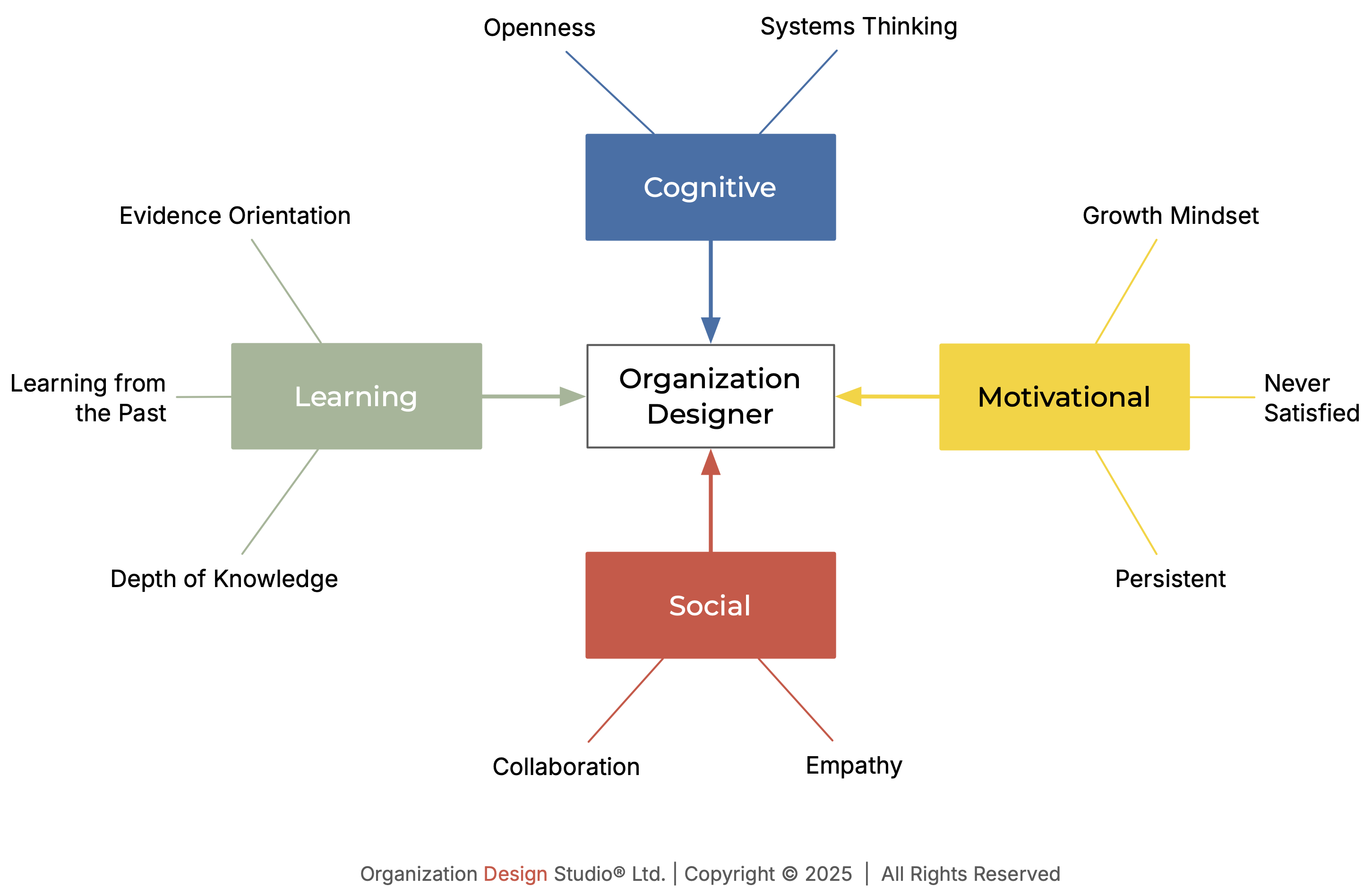
1. Cognitive Traits
How designers think about the world
Cognitive traits shape how designers perceive organizations as dynamic, interdependent systems rather than collections of parts. They predict cognitive flexibility, conceptual reframing, comfort with uncertainty, and the ability to integrate internal and external systems. Ultimately, these traits determine whether a leader can understand complexity, navigate ambiguity, and generate novel insights.
1.1 Openness to Experience
Designers are curious, flexible thinkers who explore unfamiliar domains and revise their assumptions when new evidence emerges. They ask exploratory questions, generate multiple interpretations, and thrive in ambiguity. They are the opposite of rigid thinkers. Rather, they are energized by novelty, complexity, and the possibility of better futures.
Note: Numerous studies provide strong evidence of a positive association between openness, one of the Big Five personality traits, and divergent thinking, creative potential, innovation behavior, and design (Feist, 1998; Wang et al., 2023).
1.2 Systems Thinking
Designers see the organization as a system of interconnected activities and decisions. They understand how changes in one part of the system ripple across other parts of the organization. Organization designers focus on aligning and integrating activities and decisions across the organization to improve the flow of value and enhance the overall enterprise's performance.
2. Motivational Traits
What drives designers to act
Motivational traits determine whether a designer will push for improvement, persist in the face of resistance, and uphold high standards. These traits shape how a designer shows up in their work, especially when it is difficult.
2.1 Growth Mindset
Designers believe skills can be developed. They seek feedback, learn from mistakes, and adapt. They are not threatened by challenges; they are motivated by them. They avoid the “curse of knowledge” by staying curious, humble, and open to learning.
2.2 Never Satisfied
Designers are always looking to improve things. Organization designers are never satisfied with the status quo or merely settle for “good enough” and have an ongoing need to drive continuous evolution and improvement. They seek breakthrough opportunities and innovative ways to leap beyond their competitors in the industry. This is not restlessness; it is purpose‑driven ambition.
2.3 Persistence
Designers strive to make the organization the best it can be and do not tolerate behaviors that contradict its goals and values. They do not permit behavior inconsistent with the organization's purpose and values. They are decisive and tenacious and can sometimes be demanding when it comes to organization design and performance.
3. Social Traits
How designers interact with others
Organization design is a social process. Designers must co‑create solutions, build trust, and integrate diverse perspectives. They influence without relying on authority.
3.1 Collaboration
Designers are team players. They balance inquiry and advocacy, elevate others’ ideas, and create shared ownership. They do not need sole credit or control. Designers value diverse perspectives and engage others in developing the why, what, and how of change, resulting in innovative solutions and increased “buy-in” for the change or modifications.
Note: Research has shown that differences in perspectives, values, and cognition within culturally diverse teams are positively related to team creativity and innovation, especially when tasks are complex and interdependent, such as in organization design (Wang et al., 2019).
3.2 Empathy
Designers get what it is like to be everyone else. They understand the experiences of employees, customers, suppliers, communities, and other stakeholders. This is an essential ability for effective organization design that creates value for multiple stakeholders.
Note: Research findings indicate that cognitive empathy is significantly and positively related to the quality and originality of creative activities such as problem construction (Kripal & Reiter‐Palmon, 2024).
4. Learning Traits
How designers acquire, use, and apply knowledge
Learning traits determine whether a designer grounds decisions in evidence, learns from experience, and continuously deepens their expertise.
4.1 Evidence Orientation
Organization designers combine the best from academia and practice to inform their designs. They are highly motivated to work with data and information from credible research rather than mere appearances and beliefs. Designers research and learn from other organizations to identify practices, tools, techniques, and technologies to inspire their innovative custom designs.
4.2 Learning From the Past
Designers learn from the past what works, what doesn’t, and under what conditions to design better organizations for today and the future. They are lifelong learners who think deeply and utilize historical performance trends and experiences to inform their decisions and drive effective strategies. They understand that learning drives innovation and sustainable value.
4.3 Depth of Knowledge
Designers build expertise in their domain while staying curious about adjacent fields. They understand the systems they lead; not superficially, but substantively. They bring conceptual fluency, practical experience, and the ability to apply frameworks, tools, and methods to real organizational challenges.
“Successful leaders in the future will have to become architects of enduring organizations by designing systems that create sustainable results for multiple stakeholders” (Latham, 2012, p. 7).
Leading a modern organization in a constantly changing world is challenging and uncertain. Leaders who develop these ten traits thrive in the Studio and will shape the future of their organizations.
References
Feist, G. J. (1998). A Meta-Analysis of Personality in Scientific and Artistic Creativity. Personality and Social Psychology Review, 2(4), 290–309. https://doi.org/10.1207/s15327957pspr0204_5
Kripal, S., & Reiter‐Palmon, R. (2024). The role of empathy in problem construction and creative problem solving. Learning and Individual Differences, 114. https://doi.org/10.1016/j.lindif.2024.102501
Larson, M., Latham, J. R., Appleby, C. A., & Harshman, C. L. (2012). CEO attitudes and motivations: Are they different for high-performing organizations? Quality Management Journal, 19(4). https://doi.org/10.1080/10686967.2012.11918083
Latham, J. R. (2012). Management system design for sustainable excellence: Framework, practices and considerations. Quality Management Journal 19(2). https://doi.org/10.1080/10686967.2012.11918342
Wang, S.-J., Chen, R., & Lu, H.-C. (2023). The Effect of Creators’ Personality Traits and Depression on Teamwork-Based Design Performance. Behavioral Sciences, 13(3), 248. https://doi.org/10.3390/bs13030248
Wang, J., Cheng, G. H. ‐L., Chen, T., & Leung, K. (2019). Team creativity/innovation in culturally diverse teams: A meta‐analysis. Journal of Organizational Behavior, 40(6), 693–708. https://doi.org/10.1002/job.2362
Subscribe to our free email list to stay connected to the Studio as new ideas, articles, and announcements are released.