Stakeholder-Centered Design
Have you ever been surprised by the announcement of a new organization policy? Have you ever thought, “What were they thinking?” Effective organization and management design depends on an in-depth understanding of the key stakeholders of the particular organization, system, process, or project being designed. In many cases, taking a little more time to consult key stakeholders as part of the design process could prevent or at least mitigate some of these surprises and missteps.
Organizational systems involve, influence, and impact multiple stakeholders. Broadly speaking, stakeholders include anyone who can affect the organization or is affected by the organization (Freeman, 1984; Freeman et al., 2010).
Here at the Studio, we view organizations as systems of reciprocal value exchanges among stakeholders. The organization designer's task is to identify the relevant stakeholders and what they require, then design activities and decisions that increase value across the stakeholder system while minimizing avoidable trade-offs.
The Studio Stakeholder Framework includes six key stakeholder groups: customers, workforce, investors, suppliers and partners, society and community, and the natural environment. The first three form the core triad of any business: investors, workforce, and customers (Simon, 1997). Investors provide the resources to hire the workforce, build infrastructure, and develop products and services that solve customers' problems. If the firm does this well in customers' eyes, they return and spend more (repeat business) and tell their friends (referral business), creating a virtuous cycle that grows the firm.
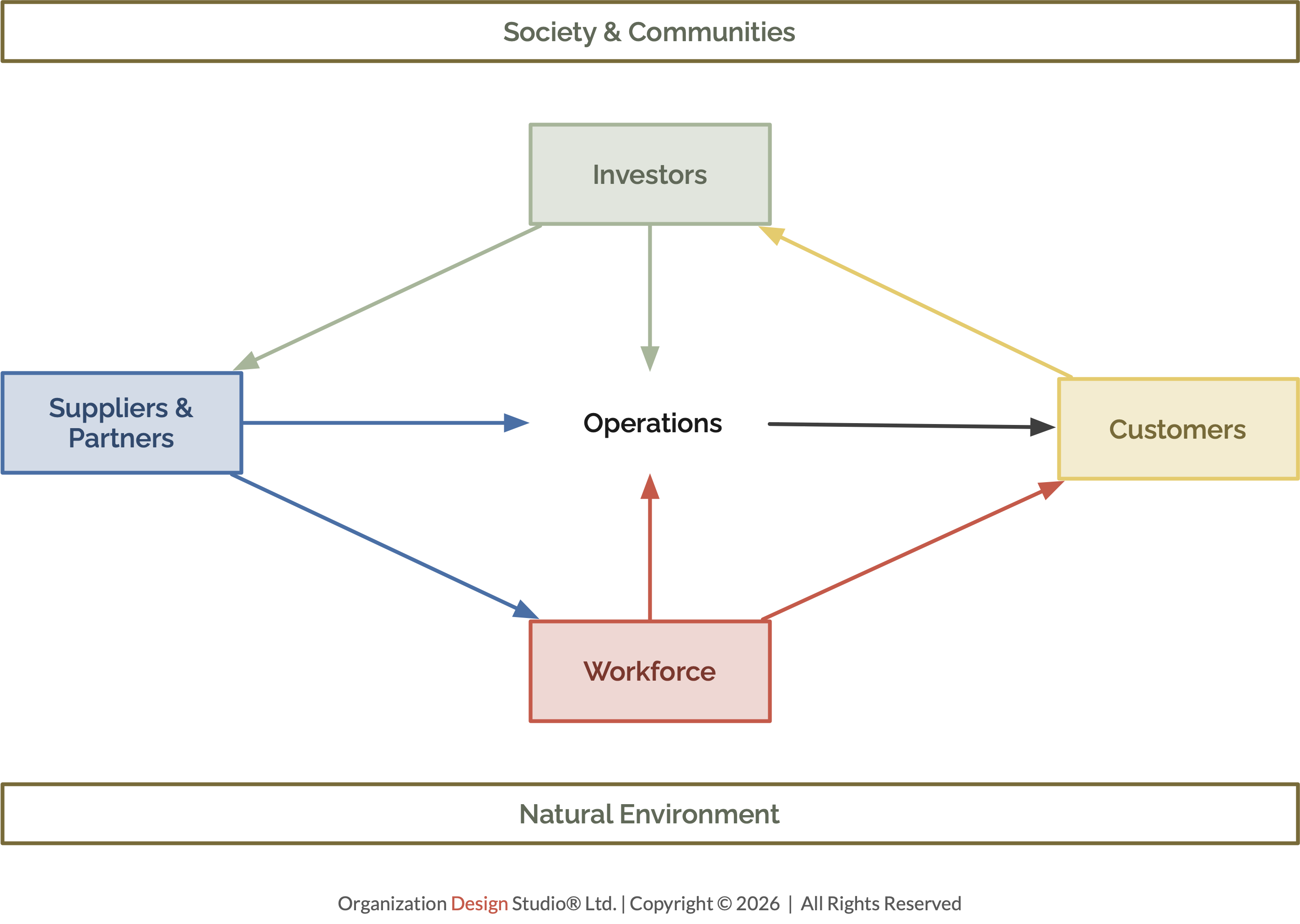
Figure 1 - Stakeholder Framework
A quick thought experiment illustrates the interdependence of this core triad. Imagine, for a moment, if any one of the three players is not meeting its own needs. Customers would leave for competitors' products and services, reducing revenue and payroll. Dissatisfied workforce members contribute less, resulting in less innovation, lower-quality products and services, and, in turn, decreased customer satisfaction and lower revenue and payroll. If investors do not get a return commensurate with the risks, they will look for other options, the cost of capital will increase, and so on.
When you add suppliers to this core group, you create an even more powerful system of value creation (Deming, 1986). The public and local communities where the organization operates are stakeholders in many aspects of its operations. Finally, the natural environment and future generations find a voice through the other five stakeholder groups and through mechanisms such as public policy and regulation. These six groups can be segmented into sub-categories based on their different needs, wants, and desires.
Customers
Following a form-follows-function approach, we start with the customers of the system being designed. Depending on the type of organization, the customers might be paying recipients of products and services, primary beneficiaries of non-profit or government services, patients, or students.
The degree to which the customer participates in producing the product or service influences the company-customer relationship and the nature of the product or service. The degree of customer participation influences what you can control regarding quality, outcomes, etc. For example, a customer at a local health club uses a service but must participate to achieve the desired results. The health club provides equipment and coaching, but the customer has to get on the treadmill and do the work to get the desired results. The health club can’t control how much effort the customer puts into their workouts, how often they work out, or how much they eat and drink. So the health club can’t guarantee results.
The more we know about customers, the better solutions and offerings we can develop. In turn, we can design better organizational systems.
Workforce
Modern workforces include members from a variety of employment situations, including employees (full- and part-time), contractors, and non-profit volunteers. Segmentation criteria fall into three groups: job type, demographics, and employment category. We begin with job type. This may be the most important factor as it informs the strategy, human resource development plans and activities, and support decisions. It seems obvious that the needs of a front-line manufacturing worker assembling tractors differ from those of a research scientist in a DNA lab. Jobs often fall into four categories or segments: physical, information, creative, and bespoke.
Within a given job type, workers' needs vary based on characteristics such as cultural background, education, and location. Workers' locations can also create different challenges and needs. For example, workers located in Rome may have very different needs than those in a small town in Western Canada or virtual workers in Asia. While this used to be an issue for a few larger multinational corporations, even some small businesses now have virtual assistants, specialists, and even manufacturing located around the world.
In addition, the relationship between workers and the organization varies from employees to contractors to volunteers, each with their own needs. Some employees are represented by formal collective bargaining organizations (e.g., unions). The contract workforce has grown over the last decade and includes a wide variety of arrangements, from delivery truck owner-operators to large contractor firms that supply pseudo-employees to a customer firm. Some non-profit organizations use volunteer labor to supplement their workforce. Volunteers offer many benefits as well as challenges for leaders. Each group has its own characteristics and needs.
Investors
Investors provide the financial resources to make the value chain possible. For-profit investors include owners, stockholders, and lenders, and they expect some sort of monetary return on their investment. Non-profit donors provide resources to run operations and serve primary beneficiaries, and they want the most impact for their donation. Taxpayers, like donors, fund government operations and want the most benefits for the least tax burden. Regardless of the organization type (commercial, non-profit, or government), operating the value chain costs money. However, each segment has different needs.
Investors' needs and motivations often vary depending on their time horizon: a longer-term perspective building a sustainable economic engine for the future vs. a temporary (short-term) interest in the company. Non-profit investors (donors) provide capital to fund the organization's activities (value chain), and they expect the greatest benefit to go to the primary beneficiaries of those non-profit services (e.g., hungry children). Government investors (a.k.a. taxpayers) provide capital and expect the best government services for the lowest tax burden.
Suppliers and Partners
A variety of external organizations provide inputs to the organization, from suppliers of components and materials to partners that share both risk and reward. Suppliers and partners are more than just raw materials and component parts dropped off on the loading dock: supplier and partner personnel are often integrated with the workforce. The more integrated they are into your processes, the more their needs become key inputs to designing your operations.
Some organizations have developed supplier segments based on the work they do and whether it is a core competency: in other words, whether it is a critical part of the business vs. a commodity. With the customer, workforce, investors, and supplier/partner segments identified, the four core stakeholders are now complete. The remaining two stakeholder groups are society and the natural environment.
Society and Communities
Organizations are inextricably linked to society and communities. Organizations produce needed products and services, employ citizens, and buy from other organizations that employ citizens. Organizations and individuals then pay taxes to fund services essential for the organizations to operate and individuals to live. All types of organizations, commercial, non-profit, and governmental, create and exchange value. Regardless of legal status, they are all integrated into one economic system.
While some organizations treat corporate social responsibility as a veneer or a department separate from other operations, creating value for multiple stakeholders and avoiding trade-offs requires integrating it into all aspects of the organization. When we fail to proactively address the needs of society and our local communities, citizens find a voice through other media. Citizens influence elected officials and government agencies, which then create policies and regulations to address their needs.
Natural Environment
The natural environment finds a voice and influence through the other five stakeholder groups. For example, some consumers will pay a premium for environmentally friendly products and services from firms that are good corporate citizens. But anyone can use money to pay for sustainability; the organization designer's challenge is to create sustainable value. If you can provide environmentally friendly products and services at a competitive price, that is a real competitive advantage.
One way to organize these requirements is to segment the natural environment into categories such as air, land, water, and energy. Then you can examine the direct linkages to the value chain, including sources, inputs (materials), use, and recycling. All too often, that reluctance stems from the notion that we have to give something up to be environmentally friendly. While that might sometimes be required, it is often a false choice.
Systems Perspective
All six stakeholder groups have needs and demands, putting increasing pressure on leaders to create value for all of them at the same time. When you step back and look at all six stakeholder groups together, it can feel overwhelming. If we view these requirements through the lens of the current system, the only solution might be compromise and trade-offs. In other words, take something from one stakeholder to serve another. Tantalo and Priem (2016) offer a particularly useful design concept that searches for actions that create different kinds of value for multiple stakeholders simultaneously without reducing existing value for another essential group.
Once you adopt a systems view, it becomes clear that a business logic of value exchanges exists between stakeholders. Plenty of examples show that it is possible to make even more money by serving multiple stakeholders, including the environment. (e.g., Anderson, 1998; 2019). The task is to move beyond individual stakeholder needs to a true system of service that aligns the stakeholders in a virtuous cycle of value creation.
For example, we begin with a highly talented and motivated workforce that creates excellent products, services, and experiences for customers. Customers are delighted and return, spending more, referring friends, and growing the top line. Investors are happy as revenue increases, and operational improvements drive greater efficiency. This flow is further strengthened by high-performing suppliers and partners who provide strong input into the value chain, earn repeat and referral business, and generate the capital to continuously improve their products, services, and operations. When we do this ethically and in ways that benefit society and the environment, we can attract talented workers, caring consumers, and risk-conscious investors. All of the above can drive even better financial performance, benefiting investors and other stakeholders through profit sharing and improved products, services, and operations.
Organization designers should not accept apparent trade-offs prematurely. They should first look for leverage points and designs that expand the value available to multiple groups. Genuine trade-offs remain, and when they do, they need to be consciously resolved rather than hidden.
Challenge of Systems Thinking
Given that there are over 50 years of research and application of the concepts of systems, you might be asking, “Why don’t more leaders take a systems approach?” “Why didn’t I learn about this in school?”
Two fundamental challenges make a systems approach difficult, and both involve how humans learn. First, humans can struggle to grasp how a system works because of the time and space between actions and results. With immediate feedback, learning is relatively easy and quick. When a delay exists between actions and results, learning becomes more difficult. In organizations, results can take months, or even longer, to show up, making it difficult to understand how a strategic decision last year affects performance a year later.
The second issue is that we teach business function by function. Business schools are typically organized into silos by functional area, such as finance, accounting, marketing, management, etc. And then we wonder why graduates create functional silos in organizations. While many business schools include a capstone strategy course to bring it all together, it is typically too little, too late. The solution is to start now with the stakeholders and build systems thinking into the organization.
The design challenge is to understand the consequences of these stakeholder choices and search for systems that create value for multiple stakeholders without shifting avoidable costs onto others.
References
Anderson, R. C. (1998). Mid-course correction—Toward a sustainable enterprise: The Interface Model. Chelsea Green.
Anderson, R. (with Lanier, J. A., & Hawken, P.). (2019). Mid-Course correction revisited: The story and legacy of a radical industrialist and his quest for authentic change. Chelsea Green Publishing.
Deming, W. E. (1986). Out of the crisis. Massachusetts Institute of Technology, Center for Advanced Engineering Study.
Freeman, R. E. (1984). Strategic management: A stakeholder approach. Pitman.
Freeman, R. E., Harrison, J. S., Wicks, A. C., Parmar, B. L., & De Colle, S. (2010). Stakeholder theory: The state of the art. Cambridge University Press.
Simon, H. A. (1997). Administrative behavior: A study of decision-making processes in administrative organizations (4th ed.). Free Press.
Tantalo, C., & Priem, R. L. (2016). Value creation through stakeholder synergy. Strategic Management Journal, 37(2), 314–329. https://doi.org/10.1002/smj.2337
by John Latham | Posted September 8, 2026
The Design Behind It
Every Result Has One
A Notebook from Organization Design Studio® - Free monthly newsletter on designing organizations that perform: practices you can use, AI methods that hold up, and evidence weighed for design.
One more step: After you subscribe, check your inbox for an email asking you to Confirm Your Email. Don’t see it? Please check your spam or junk folder.
We hate SPAM. We will never sell your information for any reason.
