
Leading Transformation Framework

Leading the journey to create sustainable value for multiple stakeholders requires the flexible combination of leveraging the forces and facilitators of change with leadership activities and behaviors, organizational culture, and individual leader characteristics. The Leading Transformation Framework is composed of 14 components described in the 14 chapters of the [Re]Create book.
Overview
Leaders who have successfully led organizations to achieve sustainable excellence focused their time on nine key activities (Latham, 2013a, 2013b). These nine key activities form a leadership system (2-10). Leadership is part art and part science; the leadership system is the science of leading transformation. The leadership system is the centerpiece of the Leadership Framework, and stakeholder value is the leadership system's centerpiece (focus). The leadership system has nine interrelated components that describe WHAT leaders do. While these are presented in sequence, the leadership system is often used iteratively, and you can begin and end anywhere on a given day.
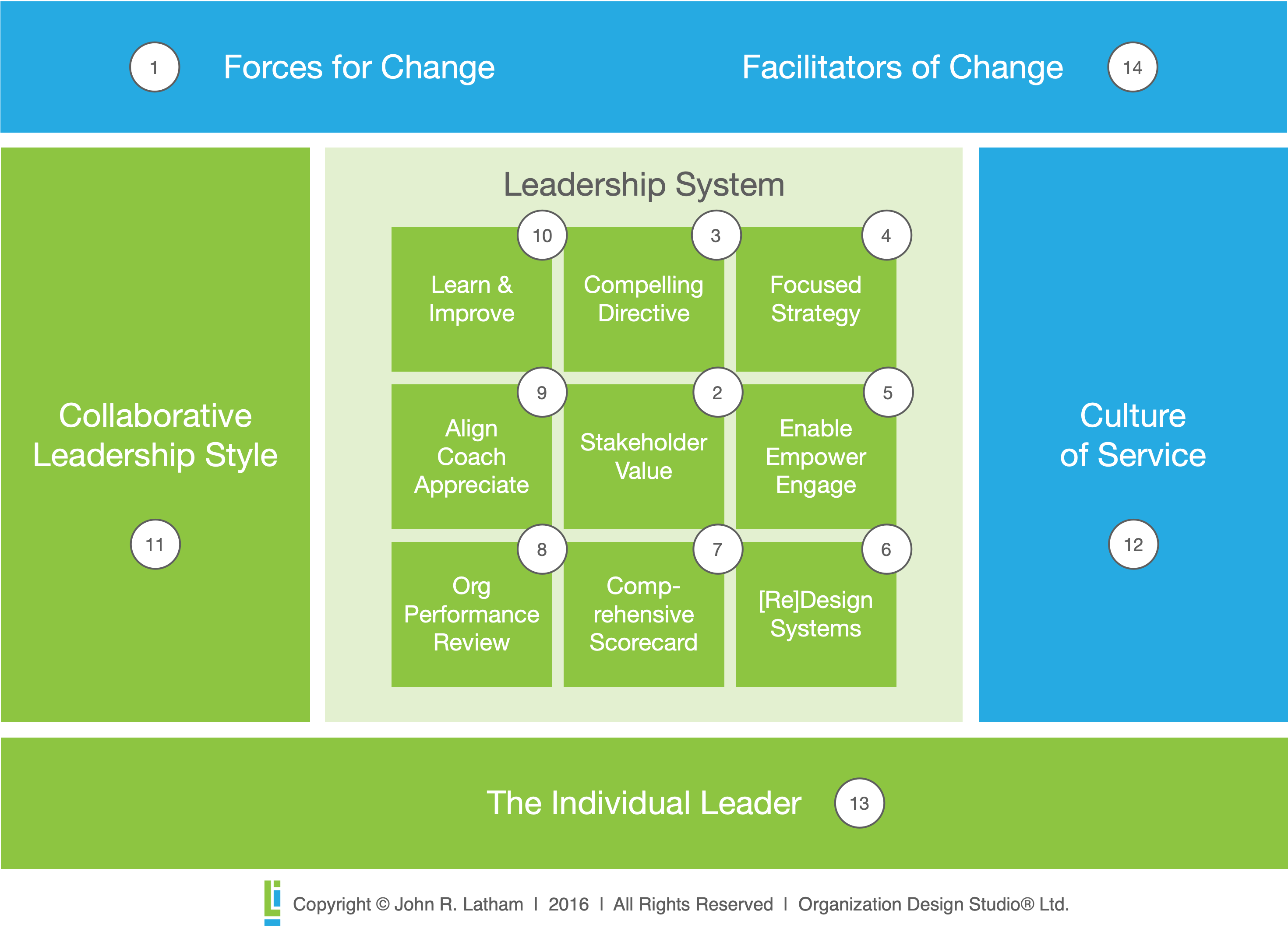
Framework for Leading Transformation to Performance Excellence
The system centers on understanding stakeholders' needs, wants, and desires (2). This understanding informs the other eight leadership system components. It starts with a compelling directive that incorporates stakeholders into the organization’s purpose, mission, vision, and values (3). This directive, in turn, is the starting point for developing a focused strategy (4) that addresses stakeholder requirements. Once the foundation is established, the workforce is enabled, empowered, and engaged (5) to carry out the strategy in ways consistent with the compelling directive. This workforce also executes the organization’s operations to deliver products and services that create value for multiple stakeholders. At the same time, they continuously improve the organization’s systems and processes by designing and redesigning them to improve performance (6). A comprehensive scorecard (7) measures the success of strategies, people, and systems by providing feedback on performance and progress in each area. This information is then analyzed and reviewed as part of a collaborative performance review process (8) that translates the information into a deeper understanding of the organization and informs changes to operations and strategy. Based on the organization’s performance review, individual performance is reinforced with rewards, recognition, and remediation (9). The last component is a continuous learning and improvement process (10) embedded in all essential systems and processes.
A collaborative leadership style (11) energizes the leadership system and describes how leaders carry out their activities. These activities and behaviors become embedded in a culture of service (12), which increases the transformation's sustainability. The individual leader (13) often must change personally to be credible and effective. The journey (14) is planned, tracked, managed, and adjusted to achieve sustainable excellence. The journey of [re]creating the organization never ends.
1. Forces for Change
While the motivation for change varies widely, there must be enough tension to overcome the inertia of satisfaction with the status quo. The framework identifies the forces of change specific to your organization and context. What are the external “pushing” forces for change? What are the “pulling” forces of change? What is the vision of a new desired future? Are these sufficient to overcome the inertia of the status quo? How can you leverage these forces to move your organization forward?
2. Stakeholder Value
The focus of a transformation to sustainable excellence is to increase the value created for multiple stakeholders, including the workforce, customers, investors, suppliers and partners, community, and environment. Focusing on stakeholder needs and relationships provides a common alignment point for the strategy, systems, scorecard, and overall organizational design for sustainable excellence. In short, high-performing organizations create an efficient system and value for other stakeholders such as suppliers and partners, society, and the environment. The task here is to understand the stakeholders’ needs and desires.
3. Compelling Directive
Stakeholder needs inform the creation of a “compelling directive.” The format of the compelling directive varies but typically consists of the organization’s purpose, mission, vision, and values. The vision describes the desired reality. The vision is essential for creating positive tension, a vital force of change that helps overcome resistance. The compelling directive builds a bridge between the stakeholders and the strategy.
4. Focused Strategy
How will the organization achieve the desired reality described in the compelling directive? The focused strategy translates the compelling directive and stakeholders’ needs into more specific goals, objectives, and clear expectations. The key here is to focus on a FEW critical goals at a particular point in time. Some organizational transformations require hundreds of changes. Success depends on choosing just a few to work on at a time, executing the plan, and then moving to the next priorities as the journey unfolds. The focused strategy is continuously evolving to meet current requirements and challenges. The focused strategy aligns the priorities through the organization and provides the foundation to enable, empower, and engage the workforce.
5. Enable, Empower, Engage
While many leaders claim that their people are their most valuable asset, their actions often tell a different story. High-performing organizations develop and engage their workforce to accomplish the strategy. Creating an engaged workforce consists of (a) acquiring and placing talent, (b) developing (enabling) and empowering people, (c) involving and engaging the workforce at all levels, and (d) addressing the whole person. Acquiring and retaining the best talent is a challenge for most organizations. The best people will only work for organizations where they feel valued, enjoy their work, and achieve their full potential in a win-win arrangement. Note: If you don’t need the best people, then consider automating the work.
6. Organization Systems
The focused strategy also drives the implementation of action plans to carry it out. There are typically two types of strategy deployment projects — those focused on new products and services and those focused on building the organizational systems to develop, produce, and deliver the products and services. Even new product launches are organizational systems that must be designed or redesigned to achieve a particular goal. The deployment of the strategy focuses on the [re]design and further development of one or more key systems to achieve an objective. The Design Framework, combined with a focus on system design, provides the structure to design, develop, and deploy any new or redesigned initiative or system in the organization. The only way we know if our redesign efforts are improving performance is to measure performance.
7. Comprehensive Scorecard
A comprehensive scorecard measures and tracks the progress and performance improvements resulting from deploying action plans across stakeholders, strategy, and systems. The comprehensive scorecard goes beyond a simple bottom line to a deeper understanding of the organization as a system. This includes both current performance and performance trends over time. Measuring performance and comparing your organization’s performance to other high-performing organizations helps create dissatisfaction with the status quo and is vital to creating tension: productive tension. The scorecard is designed to facilitate dialogue during the periodic organization performance reviews.
8. Organization Performance Review
Leaders at all levels analyze and periodically review scorecard results, then revise action plans and operations as needed to accomplish the strategy. While much of the learning during these reviews is limited to single-loop learning and keeping things on track, the dialogue occasionally examines underlying assumptions and enables double-loop learning, helping the team address root causes and prevent similar future problems. This fact-based approach to management includes organizational performance analysis that informs reinforcement of desired behaviors.
9. Align, Coach, Appreciate
There is an old saying, “What gets measured gets done, and what gets rewarded gets repeated.” Reinforcing behavior is based on progress toward the overall strategy and includes recognition, rewards, promotions, and sometimes removing individuals. All too often, incentive systems are counter-productive and drive behaviors inconsistent with the compelling directive and strategy. So caution is warranted when evaluating and incentivizing performance. High-performing organizations align incentives to ensure individual performance supports overall system performance.
10. Learn and Improve
Successful transformation leaders are never satisfied with the organization’s performance and learn from experience. Fully developing the organization’s systems, culture, and individuals requires learning from successes and failures. Organizations that achieve sustainable excellence by learning from success and failure use four common methods or approaches: the strategic management cycle, organizational assessment and improvement, continuous improvement, and benchmarking. These methods are often integrated into the other eight leadership system components.
11. Collaborative Leadership Style
The framework offers leader behaviors that support the leadership system to achieve sustainable excellence. You might consider these the art of leading transformation or HOW leaders accomplish the activities. The collaborative style includes nine behaviors. Leaders establish their credibility by role-modeling the behaviors and actions they want to see in a new organization. Organization architect leaders respect everyone, which helps them develop collaborative relationships to [re]design and transform the organization. OAs are great communicators and deliver a consistent message in any situation. At the same time, they hold people accountable for the changes. They are systems thinkers who keep learning through their involvement in design and change activities. This style helps people create the organization they want. This style, along with the activities, shapes the culture.
12. Culture of Service
Ultimately, sustaining excellence requires new systems, processes, and practices to become habitual and embedded in the culture. Culture consists of values and norms expressed through rituals, heroes, and symbols. Organizations that have achieved sustainable excellence share five cultural characteristics. They are a complementary combination of valued employees who trust each other and work as a team. At the same time, this trusting team focuses on delivering customer excellence. Ultimately, working together is the essence of sustainable change.
13. Individual Leader
Organization architects have five common characteristics that increase the odds of achieving and sustaining high performance: purpose and meaning, humility tempered by confidence, integrity, systems perspective, and motivational and attitudinal patterns. While other leadership components of the system and style are visible and observable, this one lies beneath the surface. What would it take to make this leadership style authentic for you? What motivates you to do the key activities?
14. Facilitators of Change
Some leaders of successful change doubted they could do it. It can seem overwhelming. A few critical facilitators of change can help you along the journey. First, you are not alone, so start by developing your team of organization architects. Second, begin with the senior leadership team so you will have the credibility and personal knowledge to lead the journey. Then develop a plan to guide your [re]design and transformation. There is an old saying, “If it has been done, it must be possible.”
References
Latham, J. R. (2013a). A framework for leading the transformation to performance excellence part I: CEO perspectives on forces, facilitators, and strategic leadership systems. In Quality Management Journal (Vol. 20, Issue 2, p. 22). https://doi.org/10.1080/10686967.2013.11918095
Latham, J. R. (2013b). A framework for leading the transformation to performance excellence part II: CEO perspectives on leadership behaviors, individual leader characteristics, and organizational culture. In Quality Management Journal (Vol. 20, Issue 3, p. 22). https://doi.org/10.1080/10686967.2013.11918354
The Design Behind It
Every Result Has One
A Notebook from Organization Design Studio® - Free monthly newsletter on designing organizations that perform: practices you can use, AI methods that hold up, and evidence weighed for design.
One more step: After you subscribe, check your inbox for an email asking you to Confirm Your Email. Don’t see it? Please check your spam or junk folder.
We hate SPAM. We will never sell your information for any reason.
